


 Crisis Info
 English
 Donate
 Crisis Info
 Sign Up for Emails
 Copy Link
-
Acknowledge and Discuss Differences: When children notice developmental differences, engage in open conversations that highlight both similarities and differences, fostering empathy and understanding.
-
Encourage Inclusive Interactions: Support your child in forming relationships with peers of diverse abilities to promote acceptance and reduce biases.
February 2026
Building Mental Health in the First Five Years: The 5Cs to Know

Whitney Raglin Bignall, PhD; J’Nelle Stephenson, PhD; Tyanna Snider, PsyD
Article Summary
- A child’s mental health begins developing at birth. Loving relationships, closeness and support help their brain grow and teach them about feelings and behaviors.
- Support young children with the 5 Cs: Build Connection, set Consistent Rules and Routines, give Clear Instructions, practice Co-regulation and Coping skills, and Caring for Yourself.
- If your young child often has strong tantrums, seems very anxious, struggles with sleep, avoids other kids or has physical complaints without a medical cause, talk with their primary care provider.
Activity
When should I start working on my child’s mental health?
As soon as a child is born!
The brain grows faster during the first several years of life than at any other time.
Every interaction you have with your child can foster their mental wellness. As children grow and develop, your presence and interactions create healthy relationships with your baby and child. This helps their brain grow strong connections and helps them learn how to manage and navigate their behaviors and emotions.
Additionally, tantrums and meltdowns are common and expected in early childhood. The way you support and manage these behaviors and emotions is important to the relationship with your child and their learning of managing emotions. The goal is not for young children to handle all their feelings and behaviors alone. It’s to help them learn when they can try on their own and when they should ask for help.
What helps young children’s mental health?
We use the 5 Cs to make it easy to remember!
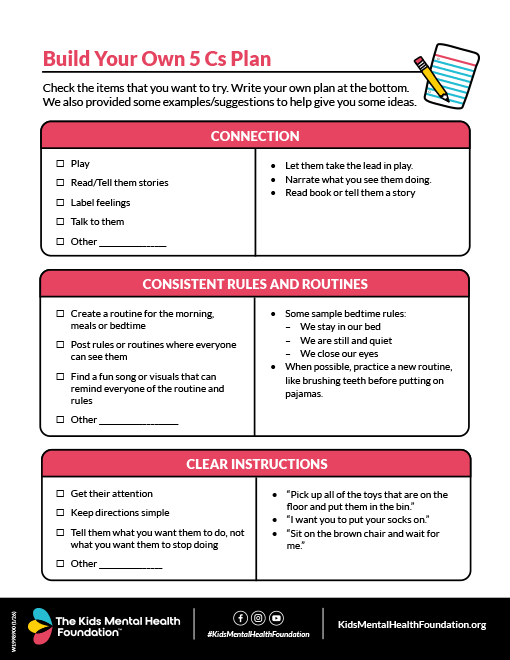
The 5 Cs are: Connection, Consistent Rules and Routines, Clear Instructions, Co-Regulation (helping a child manage their feelings by staying calm, supportive and connected so they can learn to calm themselves) and Coping, and Caring for Yourself.
|
5Cs |
Examples: |
|
Connection: a healthy parent-child relationship is foundational to mental wellness. |
0-1 years
2+ years
|
|
Consistent Rules and Routines: routines give children a sense of control and decrease behavior battles. |
|
|
Clear Instructions: simple instructions help children listen and build confidence. |
|
|
Co-regulation and Help with Coping: staying calm and connected helps children learn to calm themselves. |
|
|
Caring for Yourself: caring for your needs helps you be a better caregiver. |
|
When should I be concerned about my child’s mental health?
Children develop mental health challenges for a variety of reasons, including genetics, environment and other experiences. Look for the following warning signs in young children:
- Severe, frequent tantrums that take place multiple times per day and limit your family's ability to do what you need and want to do.
- Persistent crying or feeling/acting scared or anxious that it disrupts your family's life. This may also include doing the same actions repeatedly to keep bad things from happening.
- Difficulties sleeping, including frequent nightmares or seeming sleepy during the day more days than not.
- Trouble making friends, including disinterest in playing with other children.
- Struggling to sit still unless they’re doing an activity they like. This can get in the way of them participating or cause significant disruption.
- Complaining about physical problems (stomachaches, headaches) but medical professionals can’t find a source
If you see these warning signs in your young child, seek help from their primary care provider. It may help to keep track of the behaviors you’re seeing.
Treatment can provide support and reduce long-term symptoms and complications. Keep in mind that treatment might look different for young children and will often include significant caregiver involvement.
Taking action early can really help! Sometimes, it can be hard to reach out for help for a young child – you may wonder if they’ll just grow out of it or if it’s part of normal development.
If you have concerns from the list above, reach out to your primary care provider.
Activities
References:
Zero to Three. Advancing Infant and Early Childhood Mental Health. Zero to Three. Accessed January 2026.
Center on the Developing Child Harvard University (2017, June 19). 5 Steps for brain-building serve and return. A Guide to Serve and Return. Center on the Developing Child Harvard University. Accessed January 2026.
Gee DG, Cohodes EM. Caregiving Influences on Development: A Sensitive Period for Biological Embedding of Predictability and Safety Cues. Curr Dir Psychol Sci. 2021 Oct 1;30(5):376-383. doi: 10.1177/09637214211015673.
Cohen AK, Hazelton T, Bassey H, Gutierrez-Padilla M, Novosel C, Nichols CR, Jain S. Improving Functioning of Children Birth to Five with Emotional and Behavioral Problems: The Role of Comprehensive Mental Health Services and Supports. Pediatr Rep. 2023 Jan 9;15(1):33-44. doi: 10.3390/pediatric15010005.
Izett E, Rooney R, Prescott SL, De Palma M, McDevitt M. Prevention of Mental Health Difficulties for Children Aged 0-3 Years: A Review. Front Psychol. 2021 Sep 29;11:500361. doi: 10.3389/fpsyg.2020.500361.
Komanchuk J. et al. (2023). History of “Serve and Return” and a Synthesis of the Literature on Its Impacts on Children’s Health and Development. Issues in Mental Health Nursing, 44(5), 406–417. https://doi.org/10.1080/01612840.2023.2192794
Schore A. (2001). Effects of a secure attachment relationship on right brain development, affect regulation, and infant mental health. Infant Mental Health, 22(1-2), 7-66. doi:10.1002/1097-0355(200101/04)22:13.0.CO;2-N
Swain JE. et al. (2007). Brain basis of early parent-infant interactions: physiology, and in vivo functional neuroimaging studies. Journal of Child Psychology and Psychiatry, 48 (3-4), 262-287. doi:10.1111/j.1469-7610.2007.01731.


Related Articles
Article
Video
How to Teach Your Child About Developmental Differences

Article
Activity
How Routines Help Kids' Mental Health
- Routines help kids feel safe and build independence.
- Having regular routines can also help reduce conflict and power struggles.
- Adding routines to your life doesn’t have to be complex. You can start today and build on them over time.
Article
Getting Back into Routines
- Routines help children’s mental health by providing stability, structure and a sense of safety.
- When routines are disrupted, kids may act out with challenging behaviors or struggle with strong emotions.
- There are simple things you can do to help kids whose routine has been disrupted.
Article
Activity
The Benefits of the Outdoors on Children's Mental Health
- Being outside is good for kids’ mental health.
- Spending time outdoor door can lower stress, increase physical activity, and improve focus, mood, and sleep quality.
- There are many different ways to help kids get outdoors, even if your access is limited.
Article
Activity
Building Self-Esteem Helps Your Child’s Mental Health
- Self-esteem is how children view their abilities and self-worth.
- High self-esteem builds confidence and mental health, while low self-esteem increases risks of anxiety and depression.
- Factors like bullying, lack of choices, adults providing too much help and comparisons can lower a child’s self-esteem.
- Parents can nurture self-esteem through praise, empowerment, encouraging independence, fostering friendships, teaching positive self-talk and journaling.
Article
Celebrating Non-Majority Holidays in the U.S.

- Teaching your child about holidays your family celebrates helps them build cultural identity and provides them with information they can pass on to their friends.
- You can encourage sharing by suggesting classroom sharing and inviting friends, neighbors and families of your child’s friends to participate in celebrations.
- Encouraging curiosity and embracing cultural differences can help enrich your child’s connections with peers.
Explore KMHF
OR