


 Crisis Info
 English

 Donate
 Crisis Info
 Sign Up for Emails
 Copy Link
-
Acknowledge and Discuss Differences: When children notice developmental differences, engage in open conversations that highlight both similarities and differences, fostering empathy and understanding.
-
Encourage Inclusive Interactions: Support your child in forming relationships with peers of diverse abilities to promote acceptance and reduce biases.
October 2026
Boredom in Kids: Can it Help Mental Health?
Article Summary
- Having time without planned activities allows children to explore and entertain themselves, fostering independence and problem solving, which is good for mental health.
- Constant distraction can reduce mindfulness and creativity, both of which build mental wellness.
- You can help build time into kids’ schedule for boredom and creative play.
Activity
As parents and caregivers, we've all heard it: "I'm boooooored!"
Caregivers often feel pressured to prevent boredom in their children, constantly scheduling activities or turning to screen time, but allowing children to feel bored sometimes can actually be good for their mental health.
What is boredom?
Boredom is a result of our brains not having something to focus on. Depending on the age of your children, they may demand a quick fix to this feeling by asking for someone to entertain them or turning to a screen.
While it’s good for our minds to be active when we’re awake, both kids and adults have become used to constant stimulation. We feel this pressure to have a packed schedule of activities or technology to entertain us at every minute. No matter what we’re doing, we often find ourselves with the television on, scrolling on a device, listening to a podcast or audiobook- anything but just being quiet with our thoughts.
So now, our brains are used to having constant stimulation, and the moment that stops, our brain says, “I’m bored!”
How can boredom be an opportunity?
During times of boredom, when we allow kids to have downtime, the brain is challenged to fix the problem. This makes children more likely to come up with their own solutions and be creative. Problem solving and creativity are both good for kids’ mental health.
Additionally, allowing for downtime and boredom allows us to be more mindful of our thoughts and feelings. Instead of constantly being distracted with activities or technology, children can start to build self-awareness, insight and comfort with their own thoughts and feelings.
How can I add some “good boredom” into my child’s life?
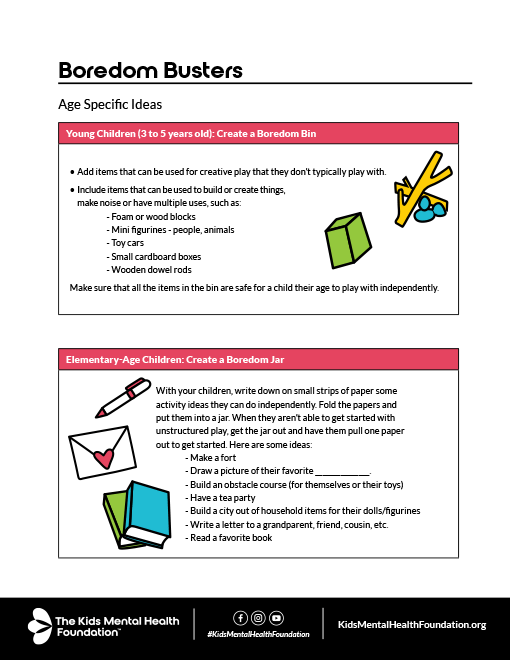
- Schedule unstructured time into the day. Leave time without any planned activities or screens in your child’s day.
- You can have a bin of items easily accessible, like art supplies or building materials to steer them in the right direction.
- You can also encourage them to spend time outside during this time!
- Be ready to tolerate some frustration. Most kids want someone to provide an activity for them, not realizing that creative play is often more engaging and satisfying. If they complain about being bored, teach them that this is their brain wanting to be more active and encourage them to come up with an idea themselves!
- Let them make a mess. Within reason, allow them to make a mess and then get them to help clean up afterward. It's worth it to have their brains active and engaged.
- Praise them. If you find them engaged in something new or different, let them know how proud you are of them. When they are done with that activity, ask them to describe how they came up with the idea or what they were doing. Let them know their imagination and creativity is something you value.
How much boredom is too much?
While letting kids feel bored for a short period of time is great for creativity, problem solving and mindfulness, we don’t want children to have low activity for long periods of time. We know that engaging in fun and pleasant activities is important to decreasing the risk for things like depression and anxiety.
If a child in your life rarely seems interested in the world around them, or seems bored when others around them are active (like during a sport or class activity), take the time to ask them about how they’re feeling. If the problem continues over time, you may want to talk with their teacher, school counselor or pediatrician.
Activities


Research References
American Academy of Pediatrics. (2025). Supporting Mindful Technology Use. American Academy of Pediatrics. Accessed August 2026.
Sheshardi A. Boost Your Brain With Boredom. Mayo Clinic Health System. September 14, 2022. Accessed May 3, 2023.
Schwartze M. Frenzel A. Goetz T. Pekrun R. Reck C. Marx A. Fiedler D. Boredom Makes Me Sick: Adolescents’ Boredom Trajectories and Their Health-Related Quality of Life. International Journal of Environmental Research and Public Health. 2021 Jun; 18(12):6308.
Related Articles
Article
Video
How to Teach Your Child About Developmental Differences

Article
Activity
How Routines Help Kids' Mental Health
- Routines help kids feel safe and build independence.
- Having regular routines can also help reduce conflict and power struggles.
- Adding routines to your life doesn’t have to be complex. You can start today and build on them over time.
Article
Getting Back into Routines
- Routines help children’s mental health by providing stability, structure and a sense of safety.
- When routines are disrupted, kids may act out with challenging behaviors or struggle with strong emotions.
- There are simple things you can do to help kids whose routine has been disrupted.
Article
Activity
The Benefits of the Outdoors on Children's Mental Health
- Being outside is good for kids’ mental health.
- Spending time outdoor door can lower stress, increase physical activity, and improve focus, mood, and sleep quality.
- There are many different ways to help kids get outdoors, even if your access is limited.
Article
Activity
Building Self-Esteem Helps Your Child’s Mental Health
- Self-esteem is how children view their abilities and self-worth.
- High self-esteem builds confidence and mental health, while low self-esteem increases risks of anxiety and depression.
- Factors like bullying, lack of choices, adults providing too much help and comparisons can lower a child’s self-esteem.
- Parents can nurture self-esteem through praise, empowerment, encouraging independence, fostering friendships, teaching positive self-talk and journaling.
Article
Celebrating Non-Majority Holidays in the U.S.

- Teaching your child about holidays your family celebrates helps them build cultural identity and provides them with information they can pass on to their friends.
- You can encourage sharing by suggesting classroom sharing and inviting friends, neighbors and families of your child’s friends to participate in celebrations.
- Encouraging curiosity and embracing cultural differences can help enrich your child’s connections with peers.
Explore KMHF
OR