


 Crisis Info
 English

 Donate
 Crisis Info
 Sign Up for Emails
 Copy Link
- Children who feel connected to their families, schools and neighborhoods experience mental health benefits.
- Feelings of belonging can be increased by modeling healthy relationship skills, providing them with opportunities and considering your child’s unique temperament.
October 2026
Handling Family Conflict

Ariana Hoet, PhD and Whitney Raglin Bignall, PhD
Article Summary
- Seeing or being involved in fighting, name calling and criticizing can be harmful to children’s mental health.
- Modeling how to handle disagreements in a healthy way can teach kids important conflict resolution skills.
- Teach kids skills like calming down, sharing their feelings, listening and problem solving to help them manage disagreements within the family or with friends.
Activity
Every family has disagreements. Learning how to work through conflict in healthy ways can help protect your child's mental health, strengthen family relationships and teach important life skills.
Families do not need to handle every disagreement perfectly. What matters most is creating a safe environment where family members can express their feelings, work through problems respectfully and repair relationships when conflicts happen.
How does family conflict affect kids’ mental health?
Research shows that witnessing and being involved in family conflict (including conflict among parents, siblings, and others) can negatively impact a child’s mental health.
Seeing chronic or intense fighting and criticizing has been linked with children struggling to control strong emotions and behavior challenges. Some children may become withdrawn, irritable or anxious.
Because children learn by watching adults, it’s important to model healthy ways to manage disagreements. It’s equally important to protect children from unhealthy forms of conflict that may occur between family members such as fighting, hitting, throwing and threats.
What should I teach my child about disagreements?
- Normalize disagreements. Help your child understand that it’s normal for people to have different opinions, ideas and feelings.
- Reassure kids that disagreement doesn’t mean lack of caring or love. Make sure your kids understand that arguments do NOT mean that your family doesn’t love one another or that you don’t love them. It just means that there are things that people have different thoughts and feelings about.
- Admit mistakes and apologize. Everyone makes mistakes. When you admit you were wrong without making excuses, you’re teaching your child how to do the same in their arguments. Kids have to learn how to apologize and it takes practice to be consistently good at this.
How to teach kids (and ourselves) to manage conflict
Use these three steps to when conflict occurs:
- Stay calm or calm down
- If you find yourself or your child is unable to cope with strong emotions, call for a time out. Go to another room and practice coping skills to calm down. Then you can return to the conversation. Good conversations happen when people are able to fully express their feelings and emotions don’t get in the way. If big feelings start to rise again, you may need to take another break.
- You can use the acronym SPACE to help your child remember.
- Separate
- Pick a place to calm down
- Assess what you need to do to calm down
- Calm yourself down
- Exit when ready and go back to the discussion
- Talk and listen to each other
- Share feelings. One of the best ways to help with disagreements is understanding and sharing feelings. Teach kids about emotions and how to name their emotions.
- Practice listening. It can be easy during a disagreement to think about what you want to say next, but focusing on what the other person is saying can help you understand why they feel and think the way that they do.
- Avoid hurtful language. Saying hurtful things, including name calling, tends to cause more anger and hurt. Try to avoid judgment words and instead focus on the facts.
Instead of saying:
Try saying:
“You are so lazy; you never do what you’re supposed to.”
“I have noticed you are not taking the trash out on Wednesdays like we agreed.”
- Use “I” statements instead of blame. Try not to blame the other person and instead focus on your own feelings and what you’d like to see differently.
Instead of saying:
Try saying:
“You are irresponsible and you made me worry. You don’t care about me.”
“I was really worried when you did not come home at curfew. We need to talk about how to make sure that does not happen again.”
- Solve problems together.
- Try to find a solution that benefits everyone. Help kids understand that compromise often means each person giving up something to find a solution that works for everyone. This could mean taking turns or finding a way to share a toy or other item of value. Of course, sometimes parents have to set firm boundaries and cannot compromise. If that is the case, we have a guided problem-solving worksheet that focuses on getting what you want while keeping a positive relationship.
How do I handle conflict between siblings?
When kids are young, they may not be in control of emotions yet. This can make acting out more common, especially towards siblings who they spend a lot of time with!
You can:
- Teach them how to express and cope with big emotions.
- Talk about your family values and rules and how you expect your kids to treat each other. You can also discuss you family rules, like “We don’t hit other people.”
- Follow up with a consequence, like taking away a toy they were fighting about. Make sure the consequences are clear ahead of time and that you follow up as discussed.
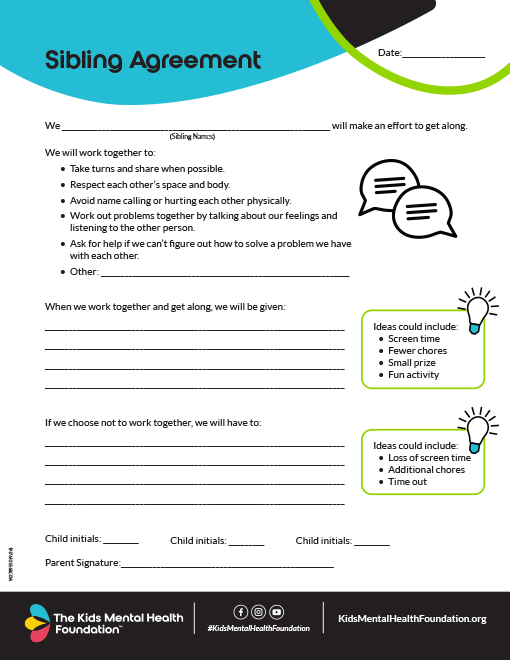
As kids get older, and arguments get more frequent, a sibling contract can be helpful to lay out agreements and consequences. Our download can help you get started.
Remember, praise and reward them when they are helpful and cooperative with each other. This will help encourage more of the behavior that you want.
When should I seek help for family conflict?
If conflict in your family is happening more days than not, or if it feels like conflicts cannot be resolved, consider seeking help from a marriage or family therapist. Any family conflict that results in physical violence is not healthy for you or your children. Call 911 or seek help through a domestic violence organization.
Activities


References
Marchesseault C. (April 2026) Family Conflict and Stress Disrupt Emotion Regulation in Youth. Yale School of Medicine. Accessed August 2026.
Kaiser Permanente. (April 2026) Learning About Managing Family Conflict. Kaiser Permanente. Accessed August 2026.
Stormshak EA. Bullock BM. Falkenstein CA. Harnessing the power of sibling relationships as a tool for optimizing social-emotional development. New Dir Child Adolesc Dev. 2009 Winter;2009(126):61-77. doi: 10.1002/cd.257. PMID: 19960535; PMCID: PMC4801185.
Related Articles
Article
Activity
Belonging Boosts Kids' Mental Health

Article
Building Connections with Kids
Learn how to build meaningful connections with kids to support their mental wellness. Explore tips and resources from Kids Mental Health Foundation for fostering strong relationships.
Article
Encouraging Student Friendships

- Healthy friendships are key to mental wellness. However, more kids are feeling isolated than ever.
- As an educator, you are able to encourage friendships to support your students’ mental health.
- Healthy friendships can help improve behavior in the class and benefit student learning.
Article
Coaching Kids Through Friendship Conflict
- All children go through friendship problems; you can build their skills and confidence in finding solutions.
- Adults can teach kids to communicate, compromise and maintain healthy friendships.
- Talking to kids about friendship conflicts can help them learn to cope with hurt feelings following disagreements with friends.
Article
Helping Children Who Feel Like They Don't Fit In
- Kids sometimes worry they don’t fit in — this is called belonging uncertainty, and it can affect their confidence, schoolwork and mood.
- This sense of uncertainty is common when starting something new (like a new school or class), and it can happen to any child for many different reasons.
- You can help by reminding kids they’re not alone, encouraging activities where they feel connected and reaching out for help if the feelings don’t go away.
Article
Activity
Helping Kids Make Friends
Teaching your child social skills may help them make friends more easily. It’s a skill that they’ll use their entire lives - throughout childhood, the teenage years and adulthood.