


 Crisis Info
 English
 Donate
 Crisis Info
 Sign Up for Emails
 Copy Link
- Body positivity is about self-positivity, acceptance, health and identifying people by their strengths and non-physical characteristics.
- It is important to discuss body positivity with children as they continue to be exposed to the portrayal of unrealistic expectations on social media.
- You can engage in positive body talk by appreciating the body for how it functions and speaking kindly about yourself and others.
January 2026
Talking to Kids About Food and Their Bodies

Eileen Chaves, MSc, PhD
Article Summary
- It is important to talk with your child about food choices and body image in a way that isn’t damaging to their mental health.
- You can start by observing your own relationship with food and your body and talking about food as fuel for our bodies.
- You can model healthy relationships with food and body image by focusing on health rather than weight and speaking positively about your body and all bodies.
It’s important to have regular conversations with your child about how they’re feeling and what they’re thinking about. But when it comes to food choices and body image, it can feel challenging to know how to talk about it in a way that won’t be damaging to a child’s mental health.
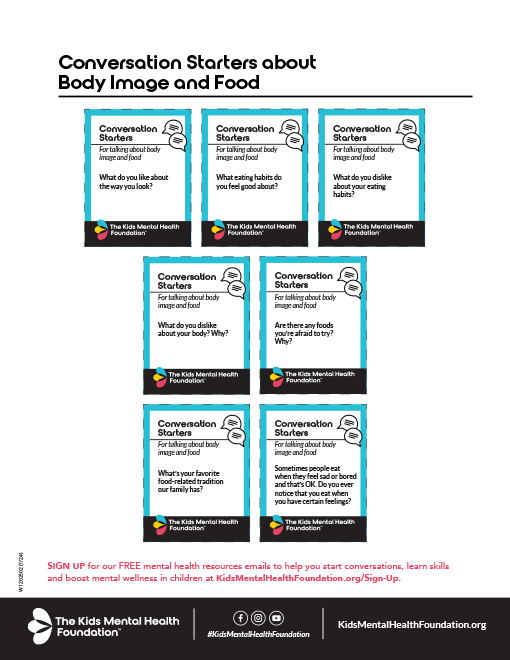
And if you have a concern about your child’s view of their body, or you think they may have an eating disorder, how do you bring that up? We have some conversation starters to help!
How should I talk to my child about food?
Food is fuel. It gives our bodies energy and helps kids grow, concentrate and play. It’s important for kids to know that food helps them do important things. Talking about nutrition that fuels our bodies is a good place to start.
Many people also have an emotional connection with food, which is totally normal. This can be positive for mental health, like when a child connects a certain kind of dessert with a relative. Having certain traditions that involve food (such as holidays) can be an important part of a child’s understanding of their family background and culture.
However, some children can have feelings tied to eating certain foods that can be harmful to their mental health, such as shame around eating certain foods or guilt for liking food, which can be tied to ideas about negative body image.
Whenever possible, start by examining your own relationship with food and how you talk about eating.
|
Instead of saying: |
Try saying: |
|
“Don’t eat that! It has so many calories!” |
“Let’s plan for one sweet treat today and save the other for tomorrow.” |
|
“That’s bad for you.” |
“Let’s think about what our bodies need right now. If we had treats all the time, it might be harder to notice when we’re really hungry for them. Saving this for later can help us enjoy it even more.” |
|
“I have such fat thighs from eating all this ice cream.” |
“Sometimes, I don’t like certain parts of my body, but that doesn’t mean I don’t like myself. Our bodies do amazing things for us. What do you like about your body?” Also, model talking positively about bodies by talking positively about your own body. You could say something like, “My thighs are strong and allow me to dance and walk.” |
|
“Are you sure you want to eat that? That has so many carbs.” |
“Carbohydrates give us quick energy but that energy doesn’t last very long. After a while, we might feel hungry again. Let’s think about foods that can help us feel full and energized for longer, like pairing an apple with a cheese stick.” |
It’s okay to make mistakes. If you find yourself repeatedly talking to your children in negative ways about your food choices or theirs, you may want to seek help from a mental health therapist.
How should I talk to my child about body image?
A lot of parents worry that even mentioning body image could give their child an eating disorder. That’s not likely! Having a healthy view of their bodies is something that you can help build at home.
- Focus on health, not weight. By talking about eating nutritious foods, exercising, focusing on mental health and self-care and having a limited amount of nutrient poor foods, you’re building a picture for them of what it means to live a healthy life.
- Model positive body image. Make a point of talking about your own body in a positive way. Talk about all the amazing things our bodies do for us, like allowing us to move in so many ways, helping us to concentrate and learn, and allowing us to connect with others through hugs and touch. Avoid talking poorly about other people’s bodies. Remember that kids pick up on, and repeat, things that they hear.
- Celebrate bodies of all shapes and sizes. You can read books, watch movies and look at art that shows people in a variety of shapes and sizes. Talk about something that you find interesting or lovely about different people.
Activities


References
Lawrence SE. Lessard LM. Puhl RM. Foster GD. Cardel MI. "Look beyond the weight and accept me": Adolescent perspectives on parental weight communication. Body Image. 2023 Jun;45:11-19.
Lessard LM. Wu R. Puhl RM. Foster GD. Cardel MI. Adolescent experiences of weight-related communication: Sociodemographic differences and the role of parents. Pediatr Obes. 2025 Feb;20(2):e13196.
Puhl RM. Lessard LM. Foster GD. Cardel MI. A Comprehensive Examination of the Nature, Frequency, and Context of Parental Weight Communication: Perspectives of Parents and Adolescents. Nutrients. 2022 Apr 8;14(8):1562.
Puhl RM. Himmelstein MS. A Word to the Wise: Adolescent Reactions to Parental Communication about Weight. Child Obes. 2018 Jul;14(5):291-301.
Related Articles
Article
How to Promote Body Positivity in Kids

Article
Healthy Body Image in Student-Athletes
- Kids can pick up on adult attitudes toward food and their bodies and that can impact a child’s mental health.
- Adults can help children have positive views of healthy eating, activity and exercise.
- Learn about warning signs that an athlete may have unhealthy eating or exercise patterns. Early treatment can be effective.
Article
Activity
Common Eating Disorders that Impact Children
- Eating disorders are psychological conditions that have physical and emotional consequences.
- It is important to learn about different kinds of eating disorders to take the right steps to support your child.
- You can help children have a healthy relationship with food and their body